Back to Directory of
White Papers
The Ultimax Group White Paper
#2001-3e
Mirrors and Smoke, & Other Shady
Schemes*
by Robert Kennedy,
P.E. and Ken Roy,
P.E.
robot at ultimax dot com and KIRoy
at ultimax dot com
A compendium of slide presentations at:
California Polytechnic
State University, Pomona (02Nov2001),
Stanford
University (14Nov2001),
to the Friends
of Oak Ridge National Laboratory (21Nov2001)
to the Oak Ridge Isochronous Observation Network
(05Dec2001),
to the IEEE Oak Ridge and
East Tenn. sections (11Dec2001),
as “Dyson Dots”, to the Seventh Symposium on Realistic Near-Term Space Missions, of the International Academy of Astronautics at Aosta, Italy (10-13Jul2011)
as “Dyson Dots”, to be at the “Problems of Adaptation to Climate Change-2011” conference organized by the Russian Academy of Sciences and Russian Federal Service for Hydrometeorology (Roshydromet) at Moscow, Russia (07-09Nov2011)
First, Looking Backward*
(*to justify this Utopian scheme)
- 1580-1600: Sunspot cycle shut down, then solar output fell 0.25%
- “Maunder minimum” (astronomers’ name for it) aka “the Little Ice Age” (historians’ name for it)
- Sunspots counted by Galileo Galilei
- Thames River froze over for first time in recorded history
- European population growth stalled
- Crops failed over most of Europe
- Iceland cut off from Europe by sea ice
- Tycho Brahe (Kepler’s mentor) recorded winter temperatures 2.7°F below average
Realize that IPCC’s lower limit (in 3rd Report; 4th is worse) of estimated Greenhouse temperature change was also 2.7°F, but in the opposite direction, so wouldn’t it be neat if...?
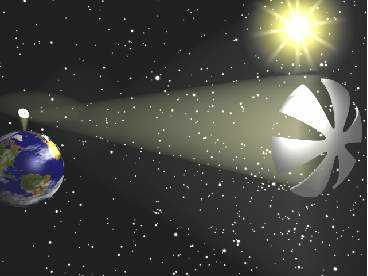
“Sunflower” by
Bill Howe, 2002
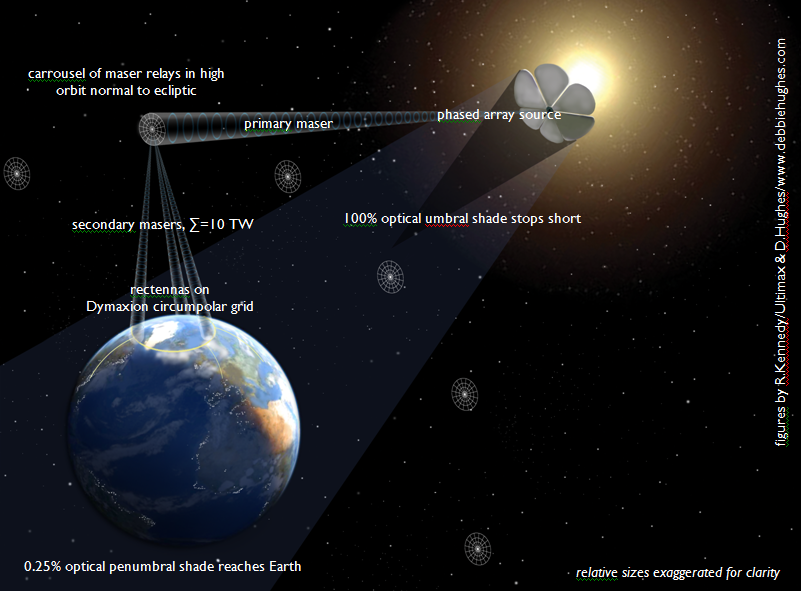
“Dyson Dot: The View from Here” by
Robert Kennedy & Debbie Hughes, 2012
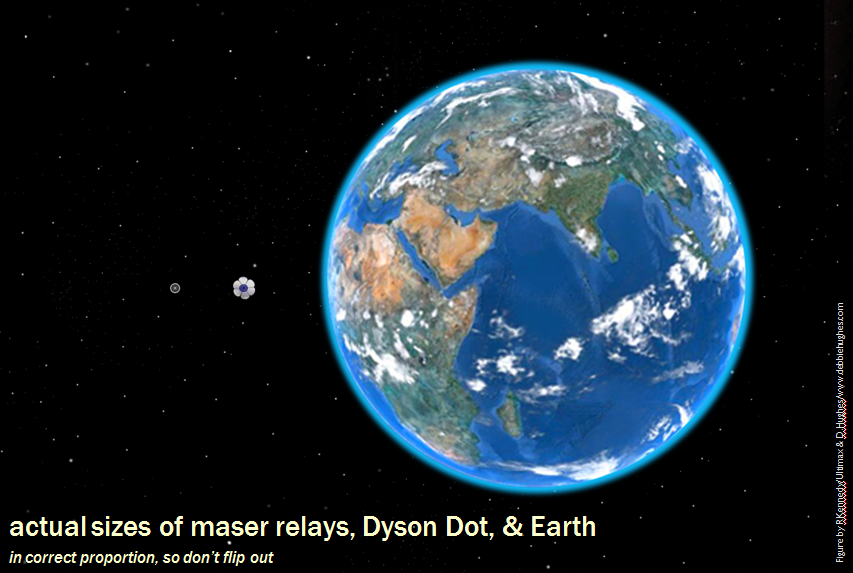
“Dyson Dot and Maser Relay to Scale” by
Robert Kennedy & Debbie Hughes, 2012
we could make a
Mirrored Maunder
Minimum by placing parasols between the Earth and the Sun?
(or, an
Engineered Ice Age?)
(or, a Giant-Rheostat-in-the-Sky, GRITS?)
(or,
Simulated Symmetric Sunspots?)
(or, Dyson Dots™)
Technically Sweet
Synergies
- Problem: 90% of the impacts of climate change are related to water - increased evaporation driving increased quantity of precipitation and severity of weather events, changing rainfall patterns in time and space.
Answer? Can’t get rid of the water - so limit the insolation which is evaporating it.
- Problem: Climate change is occurring too fast for human institutions to react.
Answer? Slow down the rate of change - stop some photons.
- Problem: Satellites won’t stay put due to Kepler’s 3rd Law, infinite fuel requirement, unstable stations.
Answer? Use reflected sunlight for fuel - steer with it.
- Problem: thousands of uncatalogued 300-m class near-Earth objects cruising 'round the 'hood; asteroid-generated tsunami most likely frequent threat.
Answer? Find the rocks, tag 'em, move 'em, use 'em for construction material.
- Problem: Not enough energy, money, time for the human race to adapt to rapid change.
Answer? Sell the captured sunlight for power, avoid the insurance hit, maybe even a major war.
- Too many eggs in this Terran basket!
Answer? Move up and out. (Tsiolkovsky: “Earth is the cradle of humankind, yes, but one cannot stay in the cradle forever.”)
Advantages
- scalable (twice the mirror yields twice the cooling)
- uncoupled (sails work independently of others)
- incremental (pay-as-you-go)
- “bootstrap”able (self-funding)
- customizable (selectively permeable shields to tailor light or filter out wavelengths?)
- minimally intrusive (an array of space mirrors would look like symmetric sunspots)
- and above all, reversible (reflectors can easily be shifted to let sunshine through again). All elegant ladies should have a parasol; so should Mother Earth!
Economic Drivers I
(all figures are close-order-of-magnitude [CoM], ±40%, in constant 2010$, US)
- Recent cost of climate-related insurance claims & gov't subsidies above background noise: $44 billion/yr
- Typically less than half the actual damage is covered (Katrina has cost $100B+ so far)
US GDP, 2010: ~$15 trillion (~30% of world total)
Global product, 2010: ~$50 trillion
Recent global insurance load as fraction of GP: ~0.1%
Long-term real product-dot since WW2: 2-1/4% (remember the “Rule of 72”)
Projected real global product, 2100: ~$300 trillion
Cumulative real global product, 2001-2100: >$10,000+ trillion
Forecast global insurance load as fraction of GP, 2100: ~1%
- weather is intensifying, disasters increasing in frequency and amplitude
- more and more people moving to more exposed, marginal lands
- more tightly coupled integrated global society transmits damage signals better
- the more people there are, the more any given material thing is worth
Sum forecasted climate-related hits @ 0.1-1.0% ramp-up: ~$100 trillion ÷ 50% = $200 trillion!
Economic Drivers II
(all CoM figures in 2010$, US)
- Long term average pop.-dot (population growth) in XX cent.: ~1-1/3%
- Note: peaked at ~2% in 1970
- Long term energy-dot since WW2: ~2-1/2%
- Long term electricity-dot since WW2: ~3-1/3%
- Conclusions:
- Over time and maturing economy, people use more energy per capita (even though energy per unit output may decrease)
- Electric energy is an increasing fraction of total,
- Also, maybe not strict cause & effect relationship but ample electricity is in fact highly correlated with standard of living and sociopolitical stability
Economic Drivers III
- Present U.S. use: 99 quadrillion Btu (1 Btu ~ 1kJ; 1 Q ~ 1 EJ)
- of which 15 quads is electricity @ the end-user
Present global consumption: ~450 quads (about the same as 1 hr of sunlight)
- of which ~70 quads is electricity
Worldwide electrical generating plant, 2010: ~4 TW
Projected worldwide requirement for generating capacity, 2050: ~18 TW
Est. overnight cost of replacing existing global generating capacity @ $4/watt: ~$80 trillion
- given 50-year economic life, must pay for it twice by 2100, plus new construction & continued growth in demand, so really ~$500 trillion on nominal cumulative capex by 2100
Est. worldwide primary energy consumption by 2050: ~1200 quads
Est. worldwide electricity demand by 2050: ~300 quads*
Economic Drivers IV
- Create trade in carbon credits?
- Human behavior is the last thing to change; what’s the pol/econ value in avoiding that?
- What’s the economic value of preserving your way of life?
- Cost of climate-related / resource war: who knows? Practically speaking, it’s infinite. (“National security has no price.”)
Another coincidence way too convenient to
ignore...
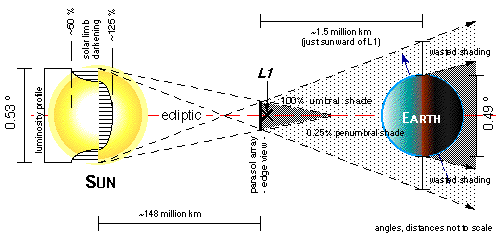
- Given: solar constant @ L1: 1400 W/m2 (all waves)
- [projected cross sectional area] π (6383 km)2 × 0.25% shading × 125% solar limb darkening factor × 82% penumbral shading efficiency = 300,000 km2, @ 30-60 grams per square meter, yields sunshade mass ~10-20 million tonnes
- (note: would be 900,000 km2 if Parasol Power located further inside at MacInnes Minimum 2.36 Gm)
- 24/365 duty cycle
- 10% of interdicted sunlight captured
- 30% photovoltaic conversion efficiency
- but 72% efficiency may be achievable (wow!)
- compare to typical 38% Carnot efficiency of thermal power cycles
80% transport efficiency via phased array masers, then... 1400 MW/km2 × 24/365 × 300,000 km2 × 0.10 × 0.25 × 0.80 × 1055 [J/Btu] = ?
300 quadrillion British thermal units (Btu), or
300+ quads!
same as projected mid-century demand for electricity! What a coincidence!
Other Grand
Constructions
(all CoM figures in 2010$,
US)
- Great Pyramid at Giza (Egypt), 2900 BCE: $?? billion
- Great Wall (China), 221 BCE-XIV c.: $?? billion
- Grand Canal (China), VI-XII c.: $?? billion
- Panama Canal (France, USA), 1878-1894?, 1904-1914: $20? billion
- Hoover Dam (USA), 1931-1936: $4? billion
- Manhattan Project (USA), 1941-1945: $20? billion
- Apollo Project (USA), 1961-1972: $150 billion
- Interstate Highway System (USA), 1955-1990: $350 billion
- Cold War nuke complex (USA), 1946-1991: $1-5 trillion
- Milstar (USA), 1977-2005: $41 billion
- SOSUS net (USA), 1980s: $17 billion
- International Space Station (int'l), 1983-2010: $95 billion
- Three Gorges Dam (China), 1990-2010: $20? billion
- Parasols to ameliorate climate change aren’t a cost center, they’re a profit center!
Don’t impose new expenses by fiat, simply harness and redirect existing/expected $100Ts in cash flows, just like harnessing the stopped light
Where to Put Parasols?
- Geostationary orbit is too valuable for other things (e.g. comsats)
- Parasol must always remain in line of sight to do any good
- Mustn’t disrupt baseload grid
- Don’t want to spend a fortune forever on boosting stationkeeping fuel
- ...so where?
The Sun-Earth L1 region obviously!
Kepler’s Laws
- All Orbits are Ellipses with Central Mass @ One Focus
- Equal Areas swept in Equal Times
- Orbital Period Squared is Proportional to Semimajor Axis Cubed (T2 = ka3)
Characteristics of Keplerian
Orbits
- Gravitational fields are conservative;
- Natural satellites fall along equipotential lines;
- No change in sum (KE+PE);
- The physical quantity of Action (KE-PE) is minimized.
- Behavior is so ingrained in our world we don’t think about it
- But think again...
Characteristics of Non-Keplerian
Orbits
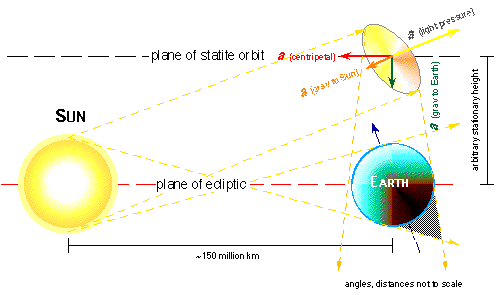
[show Robert
Forward’s “Statite” diagram]
- Objects are under continuous acceleration
- Also known as radiation-levitated orbits
- Can fly arbitrary paths, shapes, trajectories
- Patchable!
- Trouble is accelerating forever would require infinite fuel according to Rocket Equation...
- ...so don’t use rockets! use the stopped
light! (~5 micropascals per square meter @ Earth; doubled force if reflected)
Lagrangian Points I
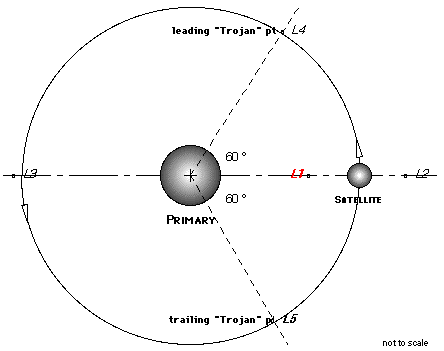
[show general
Lagrange diagram]
- At least five points exist for every pair of masses; entire set of points revolves in phase with the smaller mass
- Well defined points for Primary >> Satellite (~100:1 mass ratio or better)
- Due to shape of space-time at L-points, satellites near them behave as if they’re in orbit around point masses
- Collinear case (three unstable (libration) points on line thru Primary-Satellite) discovered in 1767 by Swiss mathematician Leonhard
Euler
- Triangular case (two stable equilibrium or “Trojan” points, 60° leading (L4) and 60° trailing (L5) satellite) discovered in 1772 by French-Italian mathematician Joseph Louis, comte de Lagrange (1736-1813)
Lagrangian Points II
[show penumbral shading
diagram]
- Sun-Earth system:
- S-E L1 is between pair of bodies; ~1.5 million km from Earth on axis; always lit; SOHO there already
- permissible “halo orbits” inside ellipsoid ~200,000 km (along solar r coord) ~800,000 km (along solar theta coord) ~200,000 km (along solar z coord) centered @ L1; always in light; NASA’s Genesis dwelt there for 6 months
- compare S-E L2, ~1.5 million km beyond mass pair; always in shadow; infrared NGST will live there
- compare Sun-Earth L3 on far side of Sun; perturbed by other planets more than Earth; totally unstable
- compare Sun-Earth L4 & L5; also perturbed by other planets exceeding Earth’s effect
Lagrangian Points III
- Earth-Moon system:
- Earth-Moon L1 aka “parking orbit” is ~40,000 km towards Earth on axis
- Earth-Moon L4 & L5 are truly stable, deep enough in Terran gravity well for restoring force
- Kidney-shaped (limaçon?) halo orbit
- L4 & L5 are rare particular solutions of general 3-body problem with M3 very small:
Lagrangian Points IV
- Other systems:
- Jupiter is big enough, unlike Earth, that its trojan points collect debris & eponymous asteroids in long period orbits;
- one set (trailing) is named for Trojan heroes -
the other (leading, and separated of course) for the Greek ones (they won the Trojan war)!
for example, 588 ACHILLES
- newly discovered trojan points leading and trailing Neptune with stability zones of huge extent (~1 billion km) containing large moon-size bodies out where the space-time geodesic is flatter
- Plus there’s chaos! (orbital resonance or orbital hopping; see the AsiaSat-3A rescue story) which facilitates transitions among orbits if you have the time
Control Issues I: Unusual control
regime
- Remote master control is not feasible -- round trip = 10 seconds
- At speed of sound in material, mechanical time lag in 1000 km structure is tens of seconds (would violate causality otherwise)
- Large sail mass(es) on order of 10-100 million tonnes depending on location
- Natural frequency is kilosecs or more
- Without medium to absorb energy, damping constant is negligible, so must either wait megaseconds or actively damp
- Could try more & smaller sails instead, but control problem expands geometrically with number of elements
- Massively distributed control architectures may require AI techniques
Control Issues II: More
- Moore’s Law, based on decreasing feature size, doesn’t work well in space -- bit-flips, logic gate killed by single proton hit
- Rad-hard electronics must tolerate 5-10 kilorads/year for decades; redundancy/self-repair needed
- Solution? Optical processors very fast, very rad-hard, friendly to non-Von architecture (candidates for strong AI maybe?)
- Halo orbit about Sun-Earth L1 point (and also L2) subject to periodic (28 day) significant gravitational disturbance (Luna) at just 1/4 distance inside
- Keeping a powerful maser(s) trained on a moving target(s) from a moving platform(s) 10 light-seconds (1 million miles each way) away without brownouts or need for customers to apply #2,000,000 sunblock
Recapping Advantages
of
(Dyson Dot™, or Giant-Rheostat-in-the-Sky or GRITS, or Mirrored
Maunder Minimum, or Simulated Symmetric Sunspots, or Non-Magical
Occultation)
- scalable (twice the mirror yields twice the cooling)
- uncoupled (sails work independently of others)
- incremental (pay-as-you-go)
- “bootstrap”able (self-funding)
- customizable (selectively permeable to filter or tailor wavelengths?)
- minimally intrusive (an array of space mirrors would look like symmetric sunspots, if they could be seen at all)
- and above all, reversible (reflectors can easily be shifted to let sunshine through again, or even to warm up the place).
Quotes
- Herman Kahn:
- “We are presently few, poor, and weak; later we will be many, rich, and powerful.”
Despite Kahn’s optimism, there may only be a century or two left in this Renaissance culture; all the cheap, easy-to-get fuel, ores, resources are gone (Peak Oil may have happened already; RAND says Peak Coal in 2020-2030); need a functioning technical civilization for Kahn’s Law of Infinite Fungibility to work.
Sagan v. Proxmire debate:
- Senator William Proxmire: “We don’t need to go into space and explore the planets now; the planets will always be there.”
- Dr. Carl Sagan: “...indeed true, but with an attitude like that, we probably would not.”
Tsiolkovsky:
- “Earth is the cradle of humankind, yes, but one cannot stay in the cradle forever.”
Play ©2001 Dyson Dots™ movie: choose Real Media Player or Windows Media Player
Answers to FAQs
- Yes, before moving asteroids around, manipulating terawatt-class directed energy devices, or disseminating self-replicating robots, the human race had better solve the problem of war first.
- Until then, send up only most trusted vetted personnel - kosmos not for hoi polloi yet
- No, maser energy does not add significantly to heat burden - natural sunlight dumps a gigawatt per km2 on ground, so 10 terawatts of power into grid equals a mere 60 mile x 60 mile rectenna @ 1 sol; factoring in waste heat/CO2 of ground-based carbon-burners, result is huge net heat reduction
- Yes, the “halo” orbit nomenclature is indeed duplicative and confusing. Gotta work on that.
- Yes, photovoltaic films are far denser than solar sail material, but power generation portion at the hub doesn’t have to be lightweight. In fact, ~100 Mt mass necessary for stability sunward of L1.
- No, selling power from space would not violate anticommercial terms of the Outer Space Treaty (which the U.S. hasn’t ratified anyway), because the sails are manufactured objects, albeit very large ones made of celestial materials, and not natural celestial bodies.
About the Authors
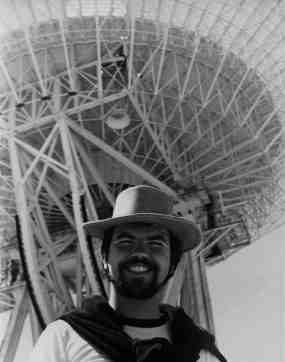 Robert G. Kennedy III, PE is president of the Ultimax Group Inc., a corporation distributed across 11 time zones from Moscow to L.A. He speaks enough languages to start bar fights in all of them. Robotics engineer, amateur historian, and jack of all trades, he spent 1994 working for the House Science Committee’s Subcommittee on Space as ASME’s Congressional Fellow. On the Sputnik anniversary in October 1997, he managed to make the Russian evening news. Robert telecommutes from Oak Ridge, Tennessee, where he resides with his wife, numerous cats, the occasional horse, and a yard full of trees and Detroit iron.
Kenneth I. Roy, PE
is an engineer working in Oak Ridge amidst relics of the Manhattan Project. Most
of his writing concerns how space technology will affect the future. Notably,
“Ship Killers from Space”, a cover story of the prestigious Proceedings of the US Naval
Institute, developed the strategic implications of basing kinetic energy
weapons in low earth orbit. Ken (together with Robert and Dr. Fields) is also the author of “Shell Worlds: An Approach to Terraforming Moons, Small Planets, Plutoids”, which appeared in the January 2009 issue of Journal of the British Interplanetary Society.
David E. Fields, Ph.D.
is a physicist, radioastronomer, and gentleman-farmer residing and working near Oak Ridge. Among other duties, he is the director of the Tamke-Allan Observatory, a public all-wave astronomy facility (visible/optical, solar, multi-band radio, and cosmic ray) near Harriman, Tennessee.
Acknowledgments
I thank my co-authors Ken Roy PE and Dave Fields Ph.D.; as well as Sasha & Alya Smirnov; John Wharton; Eric Hughes; Earl Crabb; David Woolsey; Dwayne A. Day Ph.D.; H.Keith Henson; Mike Markowitz; Steven McCauley, Ph.D.; Les Johnson; Michael R. Johnson PE; Greg Matloff Ph.D.; and B. Derk Bruins Ph.D.
All mistakes are my responsibility.
Particular kudos to:
Anton Smirnov for superb computer artistry.
Mark Seiden for the cute title.
Bill Howe for this excellent CAD rendering of a sunflower-type sail.
Bruce Sterling for the alliterative
phrase.
Ken Malpass for this pun.
D. R. Fudge of the ORION stargazing group for pointing out this excellent, and traditionally Southern, acronym.
Dave Fields for coining the Dyson Dot™ moniker.
Marianne Mueller and the AMW Committee for moral and logistical support.
Dr.-Ing. Giancarlo Genta, Ms. Giusy Spinisanta and the IAA Organizing Committee for a life-changing opportunity.
Akademik Yuriy Izrael and his colleagues at Rosgidromet and the Russian Academy of Sciences, as well as the Organizing Committee of PACC-2011 for their generosity, logistical support, and legendary Russian hospitality.
Back to top.
Back to Directory of
White Papers
Update/Event Log
15Feb2001; post original as presented to STAIF
2001
15Feb2001; covered on ABC Evening
News
20Feb2001; replace Table 1 with Tables 1-3.
23Feb2001; upload
figures and equations.
25April2001; presentation of "AntiVenuforming
Terra" at 27th Asilomar Microcomputer Workshop.
24May2001; update figures
in Tables 1-3 to reflect limb
darkening, L1
stationing.
07Jul2001: "Mirrors & Smoke" appears in Whole
Earth Review.
24Sep2001: Finish computer graphic animation of
"Mirrors & Smoke" for Belgian national television RTBF - Matière Grise (in English, “Grey
Matter”). Low-rezz version of CG video archived here.
02Nov2001: Deliver invited physics seminar "Mirrors
& Smoke: Changing the Solar Constant to a Solar Variable" at California Polytechnic
State University, Pomona.
14Nov2001: Deliver invited engineering seminar
"Mirrors
& Smoke, and Other Shady Schemes" at Stanford University Computer
Systems Laboratory Colloquium (EE380).
21Nov2001: Deliver luncheon lecture
with updated economic forecasts to Friends of
Oak Ridge National Laboratory.
30Jan2007: Advise ABC News Good Morning America re technical background and
graphic to illustrate mirrors-in-space concept:
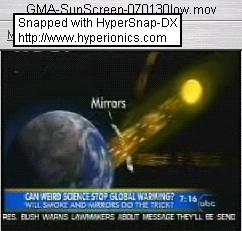 © American Broadcasting Company. Note: Not at all to
scale.
© American Broadcasting Company. Note: Not at all to
scale.
07Aug2009: Co-author Ken Roy discusses "Geoengineering to Fight Climate Change" at 67th World Science Fiction Convention (Worldcon aka Anticipation), Montreal, Quebec, Canada. The question with
co-panelists Paolo Bacigalupi and S.M. Stirling (no show!), "From giant space mirrors to
salt water sprays, are there engineering solutions to climate change?" See panel
session #2-340, 8 PM, in room P-512DH Science and Space track. See also page 51
of the
program.
13Oct2009: Lecture ORICL, update econ. figs. to constant 2008$.
2010: Update econ. figs. to constant 2010$.
10-13Jul2011: Dyson Dots presented by Robert Kennedy at “Missions to the Outer Solar System and Beyond” / Seventh Symposium on Realistic Near-Term Space Missions, of the International Academy of Astronautics at Aosta, Italy.
07-09Nov2011: Dyson Dots: Changing the Solar Constant to a Solar Variable with Giant PV Lightsails, to be presented by Robert Kennedy, PE at “Problems of Adaptation to Climate Change-2011” organized by the Russian Academy of Sciences and Russian Federal Service for Hydrometeorology (Roshydromet) at Moscow, Russia.
This site proudly powered and maintained with 
Statites © by Robert Forward.
Technical content of this paper © 2001
by the authors, Robert Kennedy & Ken Roy.
Figures #2, #3, Lagrange.gif, Halo.gif, and Penumbra.gif © 2001, by The Ultimax Group, Inc. All other material (except open-source images per GNU Free Documentation License as noted) are copyright © 1994-2011 by The Ultimax Group, Inc.
For product or dealer inquiries within the USA & Canada, call:
West Coast: (888) ULTIMAX..................................................................East Coast: (800) ULTIMAX
Outside USA: +1 (865) 405-5806 -- note number has changed
or write to us:
The Ultimax Group, Inc.
112 Mason Lane
Oak Ridge, Tennessee, USA 37830-8631
or send email to robot#ultimax_com
In all written email addresses on these pages, a hash-mark (#) has been substituted for the at-sign (@), and an underscore (_) for the period (.) in order to defeat spammers' spiders.
The entire content (images and text) of these pages is copyrighted and may not be distributed, downloaded, modified, reused, re-posted or otherwise used without the express written permission of the authors.
Privacy Policy: The Ultimax Group Inc., will never sell our customer list or distribute our customer's personal data to others without permission.
Network Abuse Policy: All incidents of suspected spam, sporging, Joe jobs, etc, derived from the misuse of the data on these pages will be investigated, reported, and prosecuted to the fullest extent of the law.
These pages last updated 09 June, 2013